The need to nurture Imagination Infrastructures
Most of the major challenges facing societies today were not caused by a lack of intelligence or information. Climate change, pandemic vulnerability, ecosystem collapse, misinformation and emerging risks from artificial intelligence were all anticipated to varying degrees. In many cases, the evidence existed long before the consequences became impossible to ignore. What was missing was not knowledge, but the ability to imagine consequences, connect systems and act early. Rather than charging blindly into crises, we have often sleepwalked into them. And we often lack the imaginative capacity (and political will) to solve a major problem… without creating another.
“We cannot solve our problems with the same thinking we used when we created them” – Albert Einstein.
Modern education systems excel at transmitting information. They are very good at teaching students how to produce ‘correct’ answers and memorise ‘facts’. They’re also good at teaching students to follow instructions and pass exams. But they are far less effective at cultivating the skills needed to ask better questions, challenge inherited assumptions or understand how social, ecological and technological systems interact. As a result, many learners leave school well-informed yet poorly equipped to recognise slow-moving risks, unintended consequences or cascading effects.
Real-world problems rarely announce themselves loudly. They creep in stealthily. They spread across systems and often remain invisible until they are costly or irreversible.
This is where imagination becomes essential. And I’m not talking about imagination as fantasy. I mean imagination as a cognitive tool. Imagination as infrastructure. It is our capacity to simulate possibilities, explore alternatives and anticipate outcomes before they arrive. Neuroscience shows that imagining activates many of the same neural networks involved in perception and experience. It allows people to mentally rehearse futures, to grasp invisible processes and to see beyond the narrow confines of the present moment. Without imagination, societies become reactive. Always responding. Rarely anticipating.
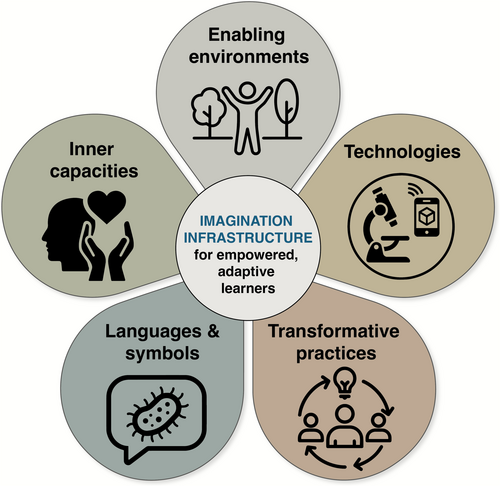
Different types of Imagination Infrastructures
As Sir Ken Robinson often suggested (and thanks to Monica Oli for the video link), children are naturally equipped for this kind of thinking. They often ask expansive questions about cause and effect, fairness and interdependence. Early childhood is a period of extraordinary cognitive flexibility, when habits of thinking are formed, and curiosity is abundant. Yet as schooling progresses, imagination and systems thinking are often squeezed out by standardisation, assessment pressures and subject silos. Creativity becomes an optional extra. A reward. Not a foundation. This is a missed opportunity because the cognitive scaffolding for anticipatory, relational thinking is built early in life.
Teaching imagination, critical thinking and systems thinking doesn’t mean abandoning rigour or lowering standards. It doesn’t require adding endless new content. Instead, it involves changing how learning happens. Simple shifts can make a profound difference. We can help students explore invisible systems and encourage them to trace how one decision ripples across health, ecosystems and communities. Using science-based storytelling, we can integrate emotion with evidence, and by asking open-ended questions, we can value understanding over recall. These approaches can deepen scientific literacy while strengthening the mental tools needed to navigate complexity.
Creative thinking allows children to:
Visualise unseen systems
Generate novel solutions
Reframe problems rather than freeze in the face of them
This isn’t ‘soft’ education. It’s preventive education. It promotes an ‘ecosystem of mind’ and diversity of thought – or as some academics would say, ‘epistemological pluralism’. Societies spend vast resources responding to crises once they erupt, yet invest comparatively little in cultivating the capacities that might help prevent them. Teaching imagination, critical thinking and systems thinking early helps future citizens recognise early warning signs, resist simplistic narratives, weigh trade-offs and design solutions that do not create new problems elsewhere. In a world shaped by ecological disruption, rapid technological change and deep interdependence, these are not optional skills. They are survival skills.
Many of the challenges ahead are already visible, even if their full consequences have not yet arrived. Whether societies respond wisely will depend on how well people can imagine futures, understand systems and act before damage becomes locked in. Education shapes how cultures think. If we want to stop sleepwalking into the next crisis, we must begin early, deliberately and inclusively.
Check out our new papers on these topics:
https://enviromicro-journals.onlinelibrary.wiley.com/doi/10.1111/1751-7915.70270
https://enviromicro-journals.onlinelibrary.wiley.com/doi/full/10.1111/1751-7915.70284
For more on this interconnected thinking, check out my books: www.jakemrobinson.com/books