Why treating ‘nature’ as somewhere to visit is bad for us – and the planet
Before I begin, a brief note on positionality: I’m approaching this article primarily through the lens of human health, so there is inevitably an anthropocentric emphasis. In my other work, I write extensively about more-than-human perspectives and ecocentrism. And, of course, the two are inseparable. Human wellbeing ultimately depends on the flourishing of the ecosystems of which we are a part.
“Spend time in nature”
I think we’ve reached the limits of this idea.
To me, the problem isn’t just the phrase “spend time in nature”. It’s the worldview underneath it that reinforces the notion that nature is somewhere else – a place we leave ordinary life to visit, before returning to the supposedly non-natural world of homes, roads, schools and workplaces.
And some folk may be thinking – and I slip into this thought myself sometimes: “Yes, yes, we know, everything is nature. And?”
While philosophically true, I understand why people regard the observation as not especially helpful. If everything is nature, then what exactly are we supposed to do with that? It can feel like one of those ideas that is so expansive it dissolves into abstraction. ‘Everything is everything’ (which, incidentally, is a bloomin’ good Lauryn Hill song).
I’ve always felt that buried in this concept there are practical consequences, even if they’re difficult to pin down. And I’m starting to think those consequences are much more substantial than we usually acknowledge. The philosophical point may be an old and ragged one – we are ecological beings, living within ecological systems all the time – but I think it’s far more than a semantic argument.
When we treat nature as a destination, we can end up designing health policy around access to parks rather than the ecological quality of everyday life.
Green prescriptions and health creation
Have you heard of ‘green’ or ‘nature’ prescriptions? I spent much of my PhD exploring this concept. And I’ve been talking to many people about it recently. It’s essentially the idea that healthcare professionals can prescribe or refer people to nature-based activities – walking groups, gardening, conservation, time in green spaces – as part of supporting health and wellbeing.
There is a lot to like about it. But the framing still often follows the familiar pattern of: a person is unwell —> healthcare system intervenes —> the person is directed towards ‘nature’. Nature becomes another treatment, another destination, another dose. We prescribe visits to green spaces while often leaving unhealthy neighbourhoods unchanged.
That doesn’t mean I think green prescriptions should disappear. I see them as valuable transitional tools. People are living in the environments we have now, not the healthier ones we might create in x number of years, and helping someone access a community garden, walking group or conservation project can have real value today. The mistake would be to confuse that intervention with the destination.
Perhaps green prescribing can therefore act as a bridge between two paradigms? In one, we help individuals access healthier ecological experiences and interactions when their everyday environments do not provide them. In the other, we ask why those experiences are absent from everyday life in the first place – and redesign neighbourhoods, schools, workplaces and health systems accordingly.
Green prescriptions could help people navigate the world we have while ‘health creation’ changes the world they have to navigate.
Prescribing may reinforce the nature–human divide. But it needn’t. It could actually help expose it. If thousands of people need to be referred elsewhere to experience social connection, meaningful activity, biodiversity, restorative environments or everyday contact with living systems, that tells us something important about the places we design, build and manage.
We also aim to restore places we recognise as degraded (like mines or felled woodlands), while often accepting ecologically impoverished everyday environments as normal. We often measure hectares of greenery rather than whether environments are functioning as healthy ecosystems.
In other words, the way we conceptualise nature determines the kinds of solutions we imagine.
From a health perspective, I think what is needed is not simply more encouragement to ‘get into nature’, at least not in the medium-long term. It’s a deeper shift – from nature as a place we visit, to health as something that emerges from the ecological conditions of everyday life. And by ecological, I don’t mean adding ‘nature’ as another determinant of health alongside housing, work, relationships, food and community. To me, those things are ecological too: they’re all parts of the living systems in which we exist and through which health is created.
This is much more aligned with the ‘health creation’ movement, something my friend, GP and Founder of Growing Health Together Dr Gillian Orrow has been helping me think through. Rather than asking only how we treat illness, health creation asks how we create the conditions that allow health to flourish in the first place.
We could push that idea further still: how do we create the ecological conditions in which life – including us – can flourish?
Of course, recognising that everything is ecological doesn’t mean pretending that every ecological interaction is benign. Pathogens, parasites, allergens, venomous animals and disease vectors are part of ecological systems too, and some interactions and exposures carry genuine risks. Risk and benefit are both part of ecology – and we are participants in those relationships, not observers outside them. The challenge is to understand them in context, respond proportionately to genuine risks, and support ecological conditions in which life – including us – can flourish.
That is a paradigm shift with very practical consequences – for healthcare, urban design, education, architecture, food systems, restoration and public policy.
As I said recently in a talk about soil(s), language shapes perception. Perception shapes behaviour. Behaviour shapes systems, and vice versa. So, even when something (like ‘spending time in nature’) seems merely ‘semantic’, we shouldn’t sweep it aside.
Here are ten practical reasons why treating ‘nature’ as somewhere to visit is bad for us – and the planet (and I promise to finish on a positive note!):
1. We accept poor everyday environments
If ‘nature’ is somewhere you visit, a neighbourhood can remain noisy, polluted, paved and ecologically impoverished while access to a park is treated as sufficient. The quality of the everyday environment becomes secondary to access to an escape from it.
2. Healthcare treats nature as an intervention rather than a condition for health
Nature prescribing can be valuable, but it can reproduce the medical model: unhealthy person —> prescribed ‘a dose of nature’ – which, incidentally, and perhaps regrettably in retrospect, was the name of my first podcast! A health-creation approach asks a different question: are the places where people already live creating the conditions in which health can flourish?
3. It puts the burden on individuals
“Spend more time in nature” requires time, mobility, confidence, transport and access. Designing neighbourhoods that support health through their everyday ecological conditions makes this infrastructural rather than aspirational – and therefore less dependent on personal resources.
4. Children get nature as an activity rather than a developmental environment
Nature becomes the school excursion, forest-school session or weekend trip. Yet children spend enormous amounts of time in classrooms, playgrounds and homes. The alternative is to make soils, vegetation, ‘dirty play’ (see Alexia Barrable and my work on this) and ecological interaction ordinary parts of childhood.
5. We forget that buildings are part of ecosystems too
The conventional story is that nature stops at the front door. It doesn’t. Air, microbes, people, pets, plants, dust and materials continually (to varying degrees depending on design) connect indoor and outdoor environments. That’s important for ventilation, building materials, cleaning practices, indoor microbiomes and health.
6. We sever food from the ecosystems that produce it
Food can become a nutritional product rather than a matter of ecological relationship. Yet soils, farming practices, biodiversity – including microbial communities – affect what reaches our plates. Seeing food as part of a living system changes how we think about nutrition, farming and health simultaneously.
7. We accept ecosystem degradation as normal in everyday places
In the field of restoration ecology, we readily talk about restoring degraded forests, farms, mines and waterways. But we rarely apply the same restoration mindset to the streets, schools, workplaces, hospitals and neighbourhoods where people spend most of their lives. If every place is ecological (and it is!), restoration needn’t be reserved for places we have formally labelled as degraded – and I would argue that many people’s living conditions, including their bodies and minds, when understood through the holobiont lens – can often be viewed as ecologically degraded. It can become an everyday principle for improving the conditions of life.
8. We mistake greenness for ecological quality
A hectare of lawn and a structurally complex, biodiverse habitat may both count as ‘green space’. Canopy cover tells us little about soil health, microbial diversity, habitat function, ecological interactions or how people actually experience a place. If every place is ecological, the question is not how much ‘nature’ we have added, but what kind of ecological conditions we are shaping.
9. Ecology becomes somebody else’s department
Once ‘nature’ is treated as a separate sector, biodiversity gets handed to parks departments and conservation teams, while housing, transport, healthcare, education and architecture carry on largely independently. But all of these are, in a sense, ecological phenomema. They shape habitats, flows, exposures, relationships and the conditions in which life unfolds. An ecological perspective therefore isn’t just something to add to decision-making – it changes how we understand the decisions themselves.
10. We miss some of our best solutions to climate and environmental change
Healthy soils, wetlands, trees and ecological complexity can simultaneously cool cities, retain water, store carbon, reduce flooding, filter pollutants and support biodiversity. If nature is regarded mainly as recreational space, we fail to recognise, restore and design ecological processes as a form of multispecies infrastructure.
Instead of asking how much nature people can access, we can ask what ecological conditions are being created in the places where people live, learn, work and play – and whether those conditions support health and flourishing.
And the final positive note!
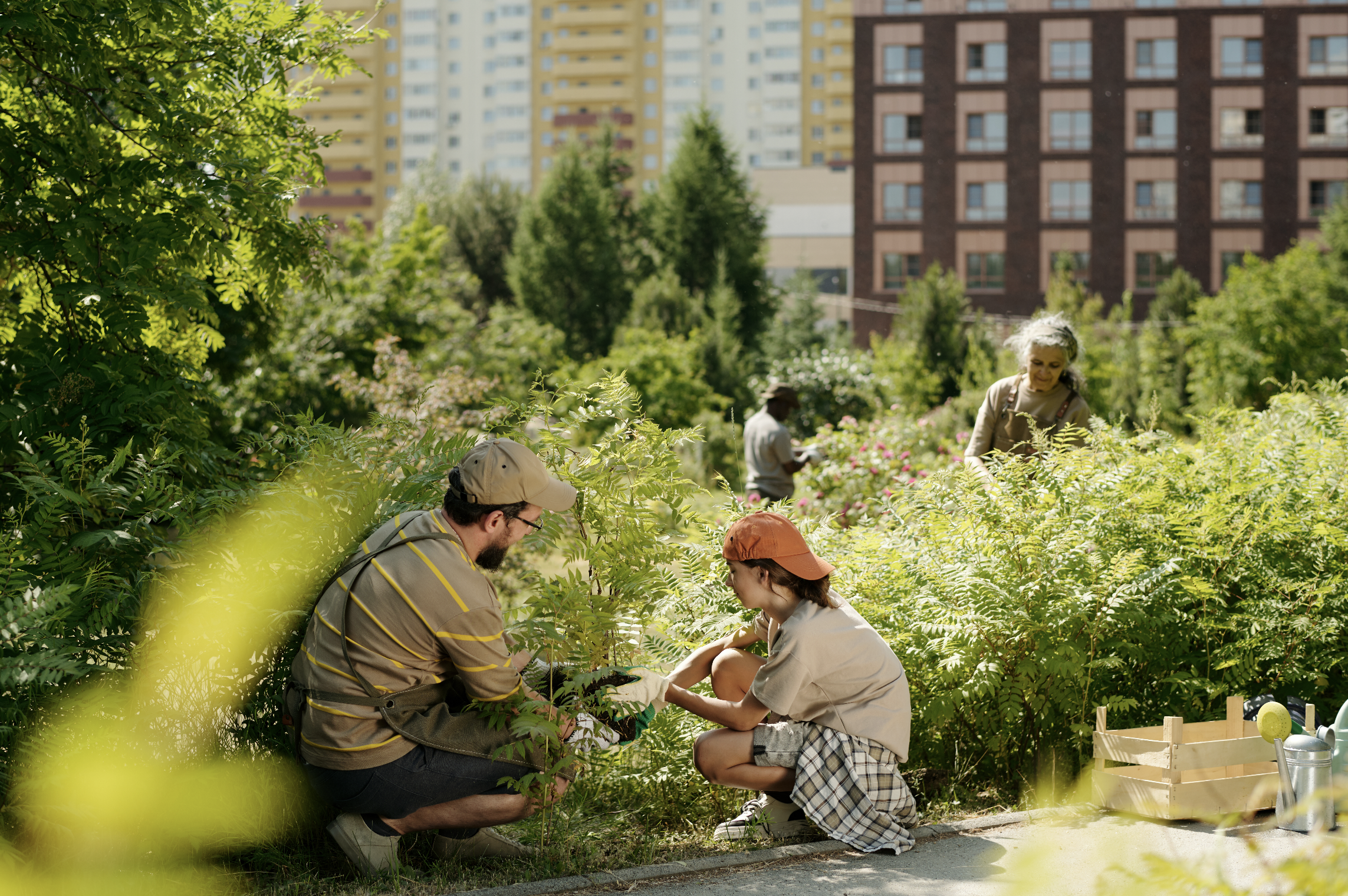
If every place is ecological, then every place is also an opportunity. A street can be more life-supporting. A schoolyard can be a flourishing habitat. A healthcare facility can be designed differently. A neighbourhood can hold more water, support richer soils, improve air and water quality, create opportunities for ecological interaction, bring people together and support life in abundance.
We don’t have to wait until we reach a park to enter an ecosystem. We’re already in one – and we’re already shaping it. The opportunity, then, is to create richer, healthier, fairer ecological conditions throughout everyday life – conditions in which life, including us, can flourish.
Nature isn’t somewhere we need to get back to or visit. It’s the living world we’re already part of – and shaping (for better or worse), every day.