“We need to get people on board first.”
A completely reasonable sentence.
When it comes to deeper systems change, this sometimes means we should begin with ideas people already understand, introduce practical interventions, demonstrate benefits, and only then challenge the assumptions underneath the system. And I agree with much of that. Change is unlikely to stick if people don’t understand it, trust it or feel part of it. New ideas need to be introduced in ways people can connect with, and institutions won’t change just because we tell them they should.
But I’ve been wondering whether there’s a trap here.
If every new idea must first be translated back into the language and assumptions of the existing system, when exactly does the deeper change begin? We’ve spent generations diagnosing, redesigning, reforming, tweaking and fixing – and somehow keep waking up inside the same broken machine.
The danger is that meeting people where they are drifts into leaving the paradigm where it is – stuck in a sticky stew of stale assumptions.
I see this clearly in the nature-and-health field, as I explored in a recent post. ‘Spend more time in nature’ is – arguably – useful advice. Nature prescriptions can help people access gardens, walking groups, conservation activities and social connection. I’ve spent years researching and advocating for some of these approaches.
But look carefully at the grammar. The person is here. Nature is over there. The person leaves ordinary life, enters nature, receives a benefit, then returns. The intervention may have some benefit while reproducing the worldview that humans and nature are separate.
Does that matter? Possibly – because the way we frame a problem helps determine which solutions become visible. If the problem is ‘people aren’t spending enough time in nature’, the obvious answer may be more parks or at least better access – or perhaps it’s those nature prescriptions.
Yet if the problem is reframed as ‘the ecological conditions of everyday life are impoverished’, we have a different arena of solutions. Indeed, much of modern life can be understood as a degraded system – ecologically simplified, disconnected and stripped of many of the relationships on which human flourishing evolved to depend. Health then, is partly a question of restoration.
Bodies, minds, schools, streets, housing, workplaces, hospitals, soils, food systems, transport, indoor environments and neighbourhood design all become part of the health question – and potential sites of ecological repair.
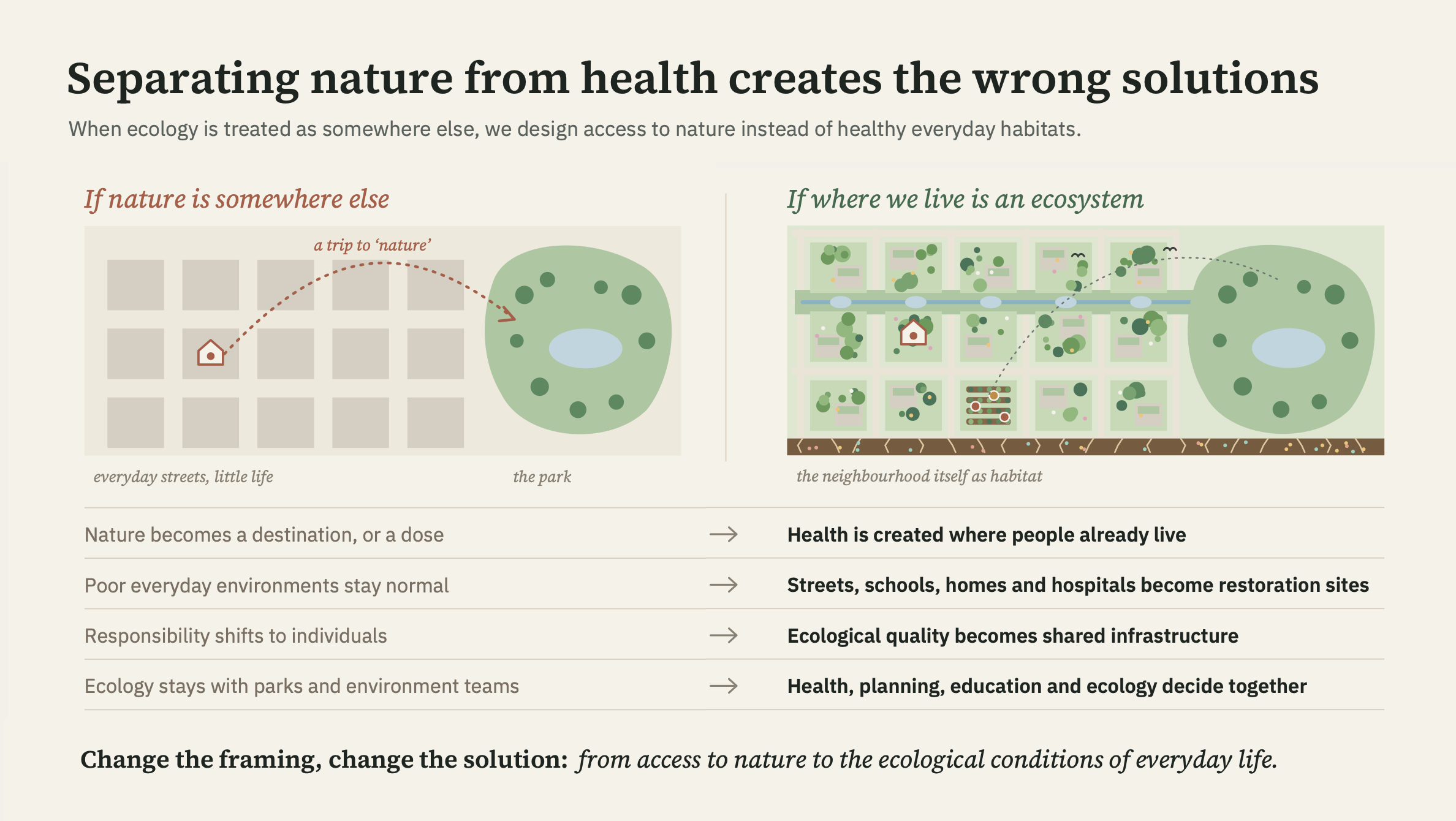
The same evidence + a different framing = a potentially different future?
Solving the problem without questioning the problem
There’s a long tradition of thinking about this in organisational and systems theory. Chris Argyris and Donald Schön distinguished between single-loop learning, where we correct our actions while leaving underlying goals and assumptions intact, and double-loop learning, where those governing assumptions themselves become open to question.
As I mentioned at the Society for Ecological Restoration Australia conference in Adelaide just the other day, the Three Horizons framework, developed by Bill Sharpe, Anthony Hodgson and colleagues, describes something similar. In the turbulent space of transition, some innovations are absorbed by the dominant system and help prolong it (H2−), while others help create the conditions from which a fundamentally different system can emerge (H2+). Sometimes innovations trick us into thinking we’re being transformative – let’s call it the transformation illusion!
I’ve started thinking about the former more broadly as paradigm-preserving solutions: interventions that improve outcomes within a system while leaving its organising assumptions intact. And by golly, once you have given something a name, it becomes uber salient. Your subconscious turns into a pack of hounds seeking it everywhere – in documents, conversations and, yes, my own work. It has become a lens I can’t quite take off.
A paradigm-preserving solution can be useful, humane and evidence-based. It can be innovative. What makes it paradigm-preserving is not that it fails. It’s that it may ‘succeed’ (or not) without challenging the assumptions that created the problem. As the familiar line goes, ‘we cannot solve problems with the same thinking that produced them’ (often attributed to Albert Einstein). Yet this is often exactly what we do: generate ever more sophisticated solutions inside the very frame that helped create the problem.
Imagine a workplace responding to chronic stress with a shiny new mindfulness app while leaving workload and culture untouched. Or picture a city encouraging cycling while keeping a transport system organised overwhelmingly around cars. Or, back to my nature example, a school introducing a weekly ‘nature session’ while children spend the rest of the week in sealed, biologically impoverished environments.
None of these interventions is necessarily bad (and might seem pretty good in the short term), and that’s precisely why this is difficult. But I feel more and more strongly that the question cannot only be “does this intervention help?” We should also ask what way of seeing the problem it reproduces – is it easing the symptoms, or changing the conditions? Is it palliative, or transformative?
Because if the underlying conditions remain intact, the next generation may simply inherit the same problem – or a worse version of it – while accepting that diminished state as normal. That is the danger of a ‘shifting baseline’: each generation begins from what the previous one learned to tolerate.
What exactly are we preserving?
This is important because the paradigms being preserved aren’t neutral backdrops. One taught us to see people as separate from the living world, and to see health as something located inside individual bodies, and to see ecosystems as resources to be managed rather than a rich trinket of relationships we depend on. The same way of seeing has accompanied the depletion of soils, a 73% average decline in monitored wildlife populations since 1970, and a rising tide of chronic, inflammatory and mental-health conditions in societies that have never been wealthier or more medically advanced.
Does that mean every modern institution is the problem? Of course not. But it does mean ‘preserving the paradigm’ isn’t a safe default. A so-called solution that makes an unhealthy system more tolerable can also make it last longer. Paradigm-preserving solutions can stealthily become paradigm-protecting ones, absorbing the pressure that might otherwise drive deeper change.
But surely we need to bring people with us?
Yes. The good ol’ notion that we need to get people on board first is important. Sometimes it’s simply good strategy. But it can also become an indefinitely self-deferring logic: we can’t challenge the paradigm until people are ready.
Yet people are mostly exposed to language, institutions and solutions produced by the existing paradigm. So that paradigm keeps determining what seems sensible, realistic and politically acceptable. “Arrrggghhh”, I hear you say. We end up waiting for the old system to grant permission for a future it may not yet know how to imagine.
Paradigm change also doesn’t necessarily require everyone to accept a new worldview before anything changes. Sometimes people experience a different possibility first.
Sometimes belief enables practice. Sometimes practice enables belief.
A caution
We should also be careful not to fetishise (try saying that word 5 times quickly) paradigm change. New paradigms are not automatically better. Existing systems contain knowledge, practices and institutions worth keeping (incidentally, that’s the H1 in the Three Horizon framework), and useful categories shouldn’t be discarded just because they’re philosophically imperfect; ‘nature’ arguably remains a useful word. Or does it?! And people living in unhealthy environments need help now, not the promise of a redesigned society in 30 years.
That’s why I still support transitional interventions. As I’ve written before, nature prescriptions can help people navigate the world we have, while health creation changes the world they have to navigate.
Bridges, not destinations
So, we should go forth and build bridges. That’s not the mistake. The mistake is confusing the bridge with the destination.
And sometimes the bridge forward runs partly backwards. Not as nostalgia, but as what I’ve come to call progression through regression: recovering relationships, practices and ways of seeing that dominant systems displaced or marginalised, then moving forward with everything we’ve since learned.
Breathe and look backwards.
In soil systems, transformative futures may depend less on ever more sophisticated technologies than on learning from long-standing stewardship and place-based practice, including living Indigenous knowledge systems, in partnership with and led by their holders, alongside contemporary ecology, microbiomics and modelling.
The same is true of health. The most radical future may not be ever more elaborate ways of delivering ‘nature exposure’ to disconnected people, but recovering the recognition that we are organisms embedded in places, communities and ecological relationships – and bringing modern medicine, ecology and public health to bear on that.
So perhaps every promising ‘solution’ deserves four additional questions:
1. What immediate problem does this help?
2. What assumptions does it leave untouched?
3. Does it build capacity for a different, better system, or simply make the existing one easier to tolerate?
4. What have we discarded that may need to be recovered before we can genuinely move forward?
The third question may be extra uncomfortable. Novelty is not transformation. We can accumulate new shiny tools and technologies, programmes, terminology and research findings while remaining inside essentially the same conceptual architecture that leads us back to the same rooms, only with different furniture.
So, we have to meet people where they are. But we must meet them where they are without leaving the paradigm stuck in that sticky stew: using familiar ideas as bridges into unfamiliar questions, delivering immediate benefits while asking what created the need for them, and letting people experience different possibilities before insisting they fully understand or endorse them.
‘Spend time in nature’ may still be a useful invitation. But, to me, the prescription feels like both a treatment and a symptom of the world that made it necessary.
Check out my new podcast: The Art of Staying Human (in an increasingly artificial world)